How Publishing Works
November 2026
This is a compilation of something that I end up typing out at least four to five times a year. Usually new novelists reach out to me and ask how they can get their book published, and we have an extended conversation on how the system as a whole works, both in Sri Lanka and globally.
I’ve decided to structure these conversations because I keep going over the same points.
Publishing is a business
This is a harsh lesson for new authors to learn, but I do have to state it here. The publisher’s costs are printing, distribution, marketing, salaries.
Their incentives can be purely profit-minded, or some combination of literary and social credibility; for example, some small publishers are dedicated to experimental literature, like Galley Beggar Press, the home of Ducks, Newburyport.
Whatever their lofty goals are, whatever you might think their duty is, they have to stay alive as a business. Thus, as a result, many publishers try to maintain a catalogue of books that sell and bring in money. Others rely on grant applications and funding from arts councils and NGOs to stay afloat.
Often, a book can be rejected because the publisher can’t sell it. This may be because they operate in a market that would turn such a publishing event into a massive loss.
For example, my first novel, Numbercaste, was rejected by Sri Lankan publishers because they couldn’t figure out how to sell near future speculative fiction. That same book was an Amazon bestseller and was picked up by HarperCollins India as part of a four-book deal, and optioned for film by Endemol Shine.
One of the Sri Lankan publishers that rejected that book, Perera Hussein, is now the publisher of The Wretched and the Damned, my Gratiaen prize-winning novel, as well as a collection of my short stories.
And I don’t resent them for turning down Numbercaste; they were right. That book has never sold in Sri Lanka in numbers that would have allowed them to break even.
What worked in an international market may not work in a local market, and vice versa. One of the finest novels to come out of Sri Lanka, in my opinion, is Shehan Karunatilaka’s Chinaman. It is a book primarily about old uncles, arrack, and cricket. Despite being practically mandatory reading in Sri Lanka and India, it has almost no audience in the US of A, where they have a shortage of drunk old uncles with a cricket obsession. They even changed the title for fear of it being offensive. [19]
Sometimes a publisher can reject a book because it is unreadable. As an author, there is a line you must walk. On one side is the idea that the publisher, and the market it operates in, cannot support your work.
On the other side is the very real possibility that your work might be bad and that you might need to revisit the drawing board and come up with something else.
We may not be able to agree on what is objectively good; the idea of good might depend on far too many different cultural factors and personal taste. But almost all of us will wrinkle up our nose at the pile of steaming shit on the road.
Keep this in mind as we go down the list.
Some nomenclature
First, let’s get some nomenclature out of the way.
1) Rights. Publishers buy the rights from you to print, distribute, and sell a work in a particular territory. These territories are divided by country or by large regional bloc. At the top level are world rights, in which you effectively sell the publisher the right to distribute the work anywhere in the world. At the bottom are country-level rights: i.e. you sell the right to distribute this book only in Sri Lanka. In the middle are regional rights - for example, Indian Subcontinent Rights means India, Pakistan, Bangladesh, Nepal and Sri Lanka.
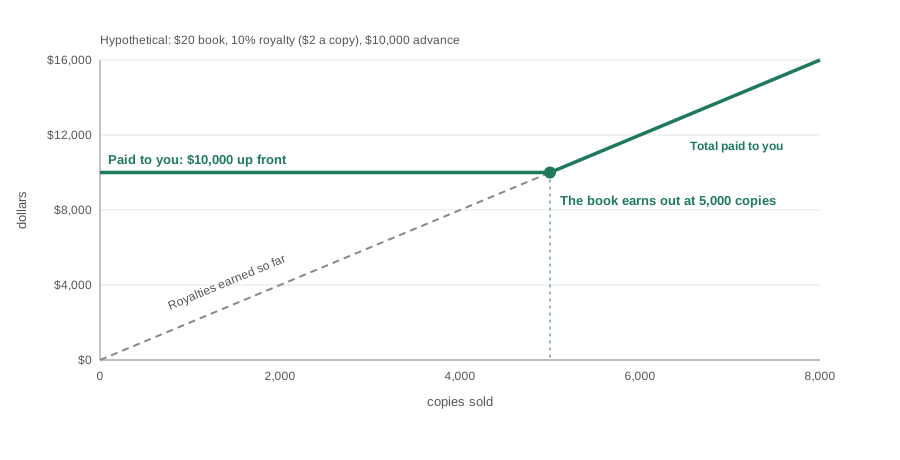
2) Royalties. Authors make money from publishers in two ways. The first and most straightforward is the royalty. Per book sold, the publisher pays you a percentage of the sticker price of that book. For paperbacks and hardcover - i.e. print books - this is usually between 8% and 12%, and 10% is very common. For ebooks, which cost less to produce, the numbers are closer to 25%. [20] If your book does well, you get 10%. If your book sells nothing, well, ten percent of zero is zero.
3) Advances. The second is the advance. A publisher, upon buying the rights to your book, can give you an advance against royalties. This is up-front money and is counted against your royalty income. For example, if a publisher gives you $10,000, they’ll recover that money from your royalties, i.e. your 10%s. Which means your book has to earn out that amount before you start seeing any royalty income.
Keep in mind, however, that with great advances also come great expectations. Big advances, that is to say, a hundred thousand dollars and up, are typically offered to celebrities who have large followings or to writers who have a strong record of sales. Typically, not always. You occasionally see a new writer being offered a huge advance, but this era of debut authors seems to have fizzled out a little, especially in light of various tragedies involving publishers betting the farm on authors who never finished their series. An advance of $10,000 to $20,000 per book in a series seems to be more normal. [20]
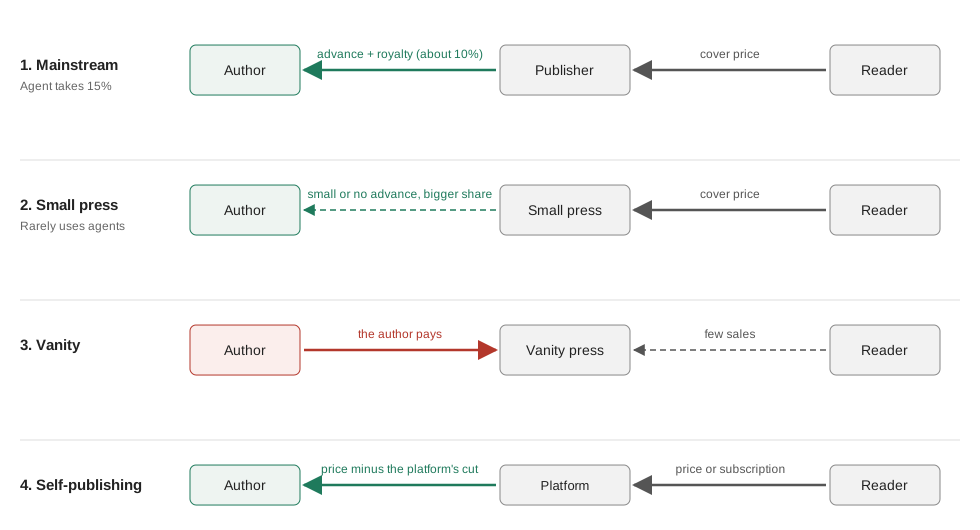
There are, broadly speaking, four types of publishers and four business models involved.
1) Mainstream publishers 2) Small presses 3) Vanity publishing 4) Self-publishing
Mainstream publishing
Big pockets, big money
For decades, a handful of houses have controlled most of the United States trade market for books, and thus most of the anglophone world: Penguin Random House, Hachette, HarperCollins, Simon & Schuster, and Macmillan. When the US Department of Justice blocked Penguin Random House from buying Simon & Schuster in 2022, the court found that these Big Five held nearly 60% of the trade market and about 91% of the books that fetch advances of $250,000 or more. [1]
These, I should stress, are not quaint operations. It used to be the Big Six before Penguin and Random House merged. These are billion-dollar corporate bodies, some of which have been around for almost a century (Penguin, for example, started out in 1935). Penguin Random House is owned by the German media group Bertelsmann, which also owns a television network and a music company. [2] Its former co-owner Pearson, which once did oil, electricity, finance, coal and aviation, now does education, having sold off the Financial Times, its stake in the Economist and its share of Penguin Random House. [3]
HarperCollins is owned by News Corp, which was run by Rupert Murdoch. [5] News Corp owned the Wall Street Journal, the UK’s The Sun and The Times, Indian real estate, some media startups. Simon & Schuster is owned by a private equity firm, KKR. [4] This is probably what passes for chess among corporate executives.
Because of this, getting published by a mainstream publisher is the goal of many a novelist. Firstly, there’s a lot more money involved. The advances tend to be higher. The print runs tend to be larger. And because of the long-standing relationships these companies have with media properties and booksellers and practically every corner of the world, they’re capable of supercharging an author’s career.
If you look at the history of best-selling novelists, particularly in the last two decades, and look at the publisher logo, you will often find they are in the position that they are because behind them is a large super corporation with tendrils reaching out to practically every corner of the world.
. . . and how they stay profitable
To keep these large corporations alive, the bread and butter of these large publishing corporations are romance, thrillers, and self-help books. The numbers shift with the source and the year, but romance is the clearest case: it was about 18% of adult fiction unit sales in the US in the twelve months to March 2021, second only to general adult fiction, [6] and in 2015 it made up nearly 20% of all US ebook sales. [7] Romantasy has since been the engine behind much of the recent growth in print. [8]
Non-fiction is a large part of the money as well, with self-help, memoir and biography, and business books leading the lists. Think of the kind of stuff written by Malcolm Gladwell or Harari or so on. Big theories of the world (tm) that can be easily converted to TED Talks but wouldn’t pass academic muster.
So, yes. The pillars of the industry aren’t clever and exotic autofiction or examinations of the inner life of a college professor contemplating joining a polycule or whatever. It’s stuff they think will sell.
The friendly face of mainstream publishing is the imprint. An imprint is a division of a mainstream publisher with its own acquiring editors, its own brand, its own style of fiction that they prefer and publish.
Imprints can be large or small. They can specialize or overlap on each other’s turf. For example, Farrar, Straus and Giroux (FSG), well-known for publishing books of great literary merit, is a division of Macmillan Publishers. Tor, a staple in science fiction and fantasy, is - again - Macmillan. Orbit is owned by Hachette.
Working with mainstream publishers
So how do you as an author work with mainstream publishing?
It’s quite rare for a large publisher, or an imprint of a large mainstream publisher, to be open to random submissions. It’s not entirely unheard of; some publishers have periods in which they open up for submissions; but by and large, the best way is getting a literary agent.
An agent is an intermediary. An agent’s job is to sign you on, read your manuscript and find a publisher who is willing to pay money for it. To do this, they pitch your book to the acquiring editors who work at publisher imprints. Often they know the editors very well and they know what kind of books the said editor is looking for, what kind of books the publisher in question has signed on, and have a good sense of what the market is looking for right now.
They may in the process come back to you with feedback and editorial details, things that you need to improve in order to be more attractive to a potential acquiring editor.
Agents also have sub agents, i.e. agents in other publishing territories who can negotiate publishing deals on their behalf. For example, a successful US-UK agent may have a Russian agent or a small press contact there, or a German agent or a publisher contact. This is how translations happen.
In return a literary agent takes a percentage of your income or advance. Typically, this number is 15%. [21] Therefore, an agent has a financial incentive to maximize the size of the advance that you can get.
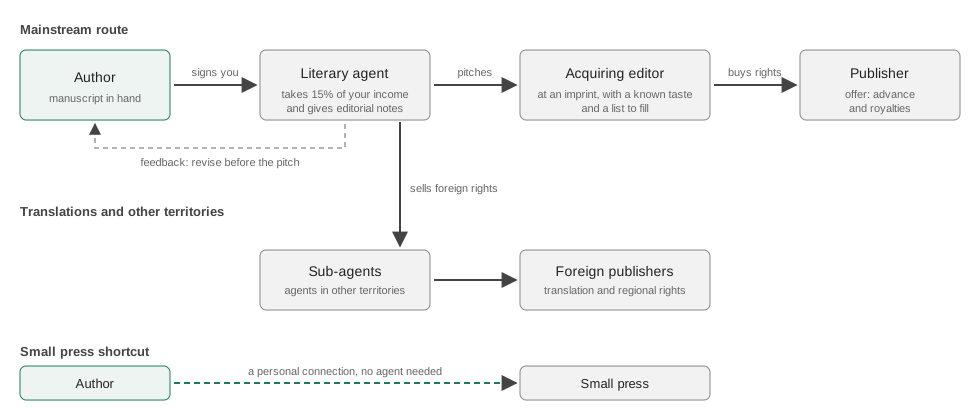
How do you find a literary agent? For me, this was a particularly difficult question since I live in Sri Lanka and the literary agents with access to publishers that dominate the Anglosphere are literally thousands of miles away. Here are ways that I know how people have found their agents:
1) at a party hosted by George R.R. Martin (so we can scratch that one out) 2) by looking up agent directories online. QueryTracker is the most popular 3) at a conference 4) at an MFA program 5) on Twitter 6) on recommendation by another author 7) by flipping to the back of books they like, looking up the agent thanks in the acknowledgements, finding their email, and writing to them 8) being reached out to by agents - usually after a stellar short story got passed around in the agent’s social circles
If you’re in the global south, like I am, number one is out. Ditto for number three. I can’t speak to number four, never done an MFA. I have been the beneficiary of number six; Chimi Tenduf-la introduced me to Kanishka Gupta, who was my first agent in India and landed me the HarperCollins India deal. My second agent, Stevie Finegan at Zeno, reached out to me on Twitter.
In turn, I recommended a few other authors to both Stevie and to Kanishka. A number of these recommendations have been successful, but I have reduced the amount of recommending I do after an unpleasant incident where a new writer demanded immediate feedback from an agent and generally acted like a spoiled ass.
I personally know people who have found success in all these methods, though.
Small press
Small presses range from agile SMEs tiptoeing around the big guns, to NGO-style organizations with a mission, to more mom and pop style outfits.
Let me explain with two examples. I’ve worked with many small presses, but two publish my novels.
One is Perera Hussein. Perera Hussein are Sam Perera and Ameena Hussein, who for decades have been publishing Sri Lankan English literature. They operate out of their house. P&H don’t make much of a profit; they have the wherewithal to publish a handful of books a year on their own dime, always one at a time.
They’re not a heavy data operation. Because they can take relatively few risks without bankrupting themselves, they lean heavily on observing local awards and hype within their social circles to see if a book has the potential to earn enough of a readership to not bankrupt them.
Recently, for example, their costs have risen because import bans and new customs policies have made importing paper from India more expensive than it used to be. Paper costs across the Sri Lankan book trade rose steeply after the forex crisis. [10]
This kind of space is fraught with commercial difficulty the world over. They have the ability to champion experimental fiction. For example, my Wretched and the Damned is made up of thirteen first-person POVs - hardly something a sane publisher would buy.
But at this scale, publishers can fall into trouble because of cash flow issues. Famously, Galley Beggar Press, which published the Booker-shortlisted Ducks, Newburyport (a thousand-page novel made entirely of a single sentence) and Women’s Prize for Fiction winner A Girl Is a Half-Formed Thing, ended up with a £40,000 hole in their finances in 2019, when the distributor Book People went into administration. [9] They had to turn to crowdfunding to sort it out.
Then let’s look at Aethon. Aethon is a small press founded by two authors, Rhett C. Bruno and Steve Beaulieu. At first they began to pick up science fiction and fantasy that had commercial viability to sell on Amazon. The advances were low to nothing, in exchange for a higher profit share.
They began to partner with audio production companies and followed an audio-and-ebook first strategy; if something sold well in digital form, then it was worth spending extra getting a print edition out. They have since acquired a majority interest in Vault Comics. [11] When web serials became huge, they pivoted to observing rising stars on the likes of Royal Road and offering them publishing contracts.
Aethon is an SME. They have staff: editors, accountants, artists, the works. They are exceptionally tightly focused on that science fiction and fantasy category, and under those very strict genres: space opera, LitRPG, Progression Fantasy, and so on.
They publish my Salvage Crew series. They got Nathan Fillion to narrate the audiobook. [12] Now in their stable of authors, so to speak, I’m as close as it gets to being the weird literary edge; their serious successes come from hyper-targeted works that have significant online followings, such as He Who Fights with Monsters by Travis Deverell.
Working with Aethon is fast and informal. Once a year I ping Rhett or Steve over email or on Facebook Messenger, and I give them an update on the next manuscript. Production happens within three to four months of me sending the completed manuscript over. Rounds of edits, cover artists, audiobook narration, all of these go into play simultaneously, and voila.
Thus, Aethon here functions more like a startup: fast and fluid, responding to niches at a much greater velocity than traditional publishers, and looking at readership data to confirm their judgements. For example, much of traditional publishing is now looking out for the next Dungeon Crawler Carl; Aethon has been playing in that space for years now.
These are two very different ways of operating. They lend themselves to very different organizational structures. Both lend themselves to creative experimentation. For example, Aethon can take on weird literary science fiction of the type that I write, as well as web serials, which few publishers were taking seriously before Dungeon Crawler Carl broke containment and a hundred editors around the world started googling “LITRPG”.
Notice how I haven’t said much about agents in this conversation. It is generally rare for agents to be involved in the small press conversation. In my experience, the small press connection is a personal connection that you have with the people running the show. They either like your work or they don’t.
Vanity publishing
Vanity publishing is a predatory mechanism by which corporations prey on new authors’ desperate desire to be acknowledged. Essentially, an author pays the publisher - instead of the other way around - to have their book printed, bound and sent out there. The Science Fiction and Fantasy Writers of America keeps a blunt guide to how the model works. [18]
Vanity publishing is stupid. It is also a derogatory signal in publishing circles. To me it means that not only could you not find someone who would pay for your work, but you also managed to get suckered into paying them for it.
Self-publishing
When I first started writing, self-publishing was, at least online, considered to be about on par with vanity publishing.
It turned out self-publishing has a rather interesting history. Self-published authors include: Leo Tolstoy, Charles Dickens, Alfred Lord Tennyson (who wrote the magnificent poem Ulysses), Beatrix Potter, Margaret Atwood, Marcel Proust, Ernest Hemingway, D.H. Lawrence, Walt Whitman, Mark Twain, John Grisham . . . [14]
Absent large commercial bodies to approve your work, self-publishing turns out to be a fairly normal default.
Today’s self-publishing is dominated by
a) getting your local printer to print copies, and distributing them yourself b) putting it up on a personal website or social media, ie: Rupi Kaur or c) Amazon, the 800-lb gorilla in the room
Printing it yourself
A friend of mine does this thing where every so often he writes a book, goes to a printer, gets about 500 copies done, throws a party, hands it to whoever comes, and then spends the rest of the year trying to get rid of the excess inventory.
This is one side of the print it yourself tree. The other side would be Brandon Sanderson, who did a record-breaking $41 million Kickstarter for four books. Said books are not just ebooks, but - at the highest tier - were beautifully decorated hardcovers with bind with custom leather bindings, maps - a whole box of goodies, if you will. This meant that Sanderson essentially ended up building his own publishing company for the manufacturing, the shipping, the inventory, all of it.
I used to work at tech magazines, one of which was basically just above that low end of the spectrum. Every month, I’d rush together the cover design, finalize the text, take it off to the printers, worry over bleed margins, go stock bookshops, take inventory and argue over commissions -
I’m going to be honest and say I would rather never do that again.
That being said, there are people who enjoy this sort of thing. A friend of mine does fonts. Do it if this appeals to you.
Amazon
Self-publishing really took off somewhere around 2009-2010. There was the combination of multiple factors.
One, the Amazon Kindle launched in November 2007. [13] Amazon had started putting the tools together for its KDP platform, by which an author could upload a formatted epub and PDF and go through the process of making it available. Over the years, they made this tooling better.
Two, social media really started to take off. Thus, a portion of the marketing power that was traditionally available only to large organizations paying for ads in newspapers and in Times Square billboards fell into the hands of authors.
So, from this era, you have juggernauts such as Hugh Howey, Amanda Hocking, Colleen Hoover, Michael J Sullivan and so on. Spurred on by these successes, many authors began to essentially everything but kitchen sink onto Amazon. Some took off to wild success (there was a veritable storm of paranormal and urban fantasy at some point) and some . . . did not (ie: a lot of poets, people trying to bring back ‘hard’ scifi from the 70s).
By the time I arrived on the scene things were becoming a lot more professional; writers were beginning to act more like organized businesses. Much data had been collected. People had noticed that the stuff that sold were the same kind of things that the big publishers put out: romance, thrillers, science fiction and fantasy.
Writers who were doing well were spending thousands of dollars on cover art editing - and indeed, some writers had already morphed into pseudo-publishing operations.
Amazon has a second ace up its sleeve, the so-called Kindle Unlimited Reading Program, which kind of acts like a Netflix subscription, but for books. Writers get paid per page read, but critically, you can’t participate in this program if your book is available for sale as an e-book elsewhere.
To the best of my knowledge, all other attempts to make e book ecosystems have simply failed to match Amazon’s sheer weight. Google Play, Apple Books, Lulu and a dozen other names have come up, but I don’t see them being talked about by actual authors.
Websites and serials
People putting stories online is not a new thing; Literotica and various fanfiction sites have been around for a long time.
A few authors like John McCrae, also known as WildBow, began to publish multi-volume epics like Worm online using WordPress sites. Andy Weir started writing The Martian online. [15] And companies like Wattpad, Royal Road and so on began to notice rising trends, particularly in countries like China, Japan, and South Korea, of people reading chapter by chapter on their phones, and decided this was a business model.
Thus, while some writers threw themselves into the Kindle ecosystem, over the next few years a different self-publishing ecosystem coalesced: websites that would easily allow non-technical authors to publish their work in a chapter-by-chapter fashion, very Dickensian, as well as crowdfunding sites like Kickstarter and Patreon, where an author who had many readers come to their web serials could direct readers and say, Hey, support me for the low, low price of a dollar or five dollars a month.
Today the largest works of fantasy, for example, are not published through traditional large publishing houses. This year alone, I’ve read A Practical Guide to Evil, The Calamitous Bob, Vigor Mortis, He Who Fights with Monsters, Industrial Strength Magic.
These are works large enough that they would take up several shelves; it is not uncommon in this space for the average successful work of fiction to span well ahead of a million words. In fact, I lost count of Pirateaba’s The Wandering Inn when it passed 14 million words. I think it’s now considerably longer. [17]
This is an altogether different publishing model, and for those who make it work, it is very successful. Authors at the top routinely report anywhere between $10,000 to $50,000 a month in earnings. They are essentially working in a style similar to a TV series: putting out multiple chapters a week, large arcs, and overall, a world and characters and a story in which people can be immersed for a while.
Often, successful authors will then either self publish completed works as volumes on Amazon or receive publishing offers.
Note that the novel and manuscript workflow is not the keystone here. These writers rarely have the luxury of writing an 80,000 word manuscript and then going back and editing and redrafting and waiting for a few years for it to come out. This is much more live.
There’s also a noticeable tilt in the types of fiction that become popular here, whereas traditional publishing seems to have tilted towards merging romance and fantasy, hence the romantasy genre (do you want to ride your dragon?). Web serials seem to overwhelmingly tend towards progression fantasy. Journal analysis will have to be a later post - we’re already running too long as is - but different types of readers are drawn to different media.
This is something you as an author have to be aware of.
A General Note on Marketing
There’s a general idea that I’ve seen on forums that as a self-publisher you have to be doing a great deal of marketing yourself.
This is true, but note: you have to be doing a great deal of marketing regardless of which publishing option you pick, unless you happen to be one of the blessed few that Penguin Random House or HarperCollins decides to sink a seven-figure publishing deal into - at which point your life will be orchestrated by an entire marketing department who will make you promote whether you want to or not.
I’m not even remotely in the same league and I still have to pay attention to marketing’s emails on when to reveal covers, what promos to push where, and so on.
So what do you do as a writer?
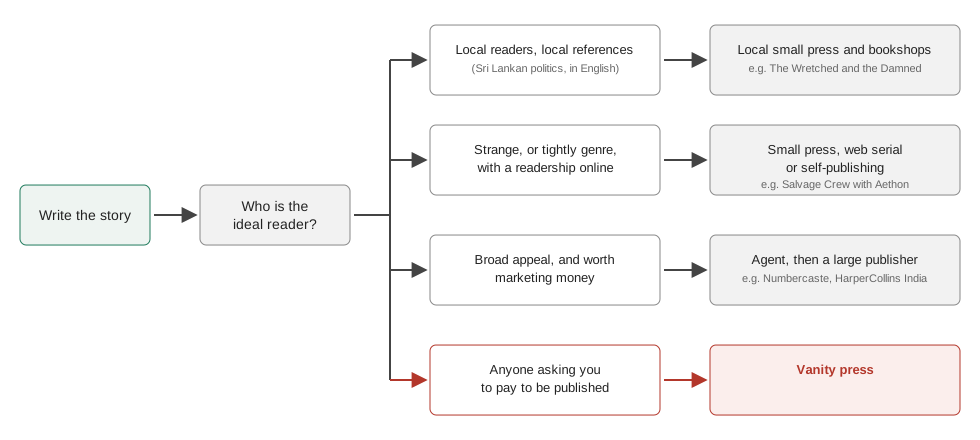
Well, first, write your story.
I say this because I have been contacted by many would-be authors who start worrying about these distribution problems before they do the most critical component. You need something to show people. You need to write.
Then take off your artist hat; put your business hat on and start thinking about where your ideal reader is going to be.
For example, if you, like me, have written a very Sri Lankan novel about Sri Lankan politics, that is full of very Sri Lankan references, then it follows that your audience is going to be Sri Lankans. If it is written in English, then it follows that your audience is going to be Sri Lankans who read English novels. Therefore, it follows that working with the Sri Lankan press and with Sri Lankan bookstores where English readers come to makes a great deal of sense.
You will need to do this on a per-project basis. Let’s take, for example, my science fiction, like the Salvage Crew. The Salvage Crew is a series of technical experiments, and I’m essentially exploring my own apophenia; it inhabits an awkward space, exactly midway between “spaceship go boom” and “existentialist cosmic intelligence re-engineers Buddhism from first principles.”
This is the kind of thing that there is a readership in the US and the UK for, but not the kind of thing that a large publisher will want to take a gambit on. Therefore, it made sense to work with a small agile press that could take risks.
Now let’s look at my upcoming fantasy novels with Tor and Erewhon. My fantasy work is inspired by my favourite writers: Terry Pratchett, Diana Wynne Jones, and others. The story is something that both my agent and Diana Pho (my editor at Erewhon, who saw this novel when it was just a short story in an anthology) saw a great deal of potential in. They figured that it fit well in the rising popularity of more cozy fantasy - but at the edges, with a little bit of sharp humor in it.
That fit the profile of what I thought my book was about, and so I gave it to the people who could get that book in front of the readers I want.
Other books that I have planned explicitly do not fit into this style, so who knows where they will go to?
Who knows. I’ll have to write the book and then put on my business hat and see.
In fact, I use the frame projects because sometimes thinking of books is a limiting frame. For example, one of my largest projects was something called Witness, a sort of solar-punk-climate-and-economic-futures project that involved co-designing a fictional floating city in which you could test any given social contract to see if it could actually be viable. And so we have theocratic ora et labora societies informed by Benedictine monasteries; we have Hayekian capitalist spaces where even money is deregulated; we have anarchist communes - and all of this is really a sprawling mess of forum posts, invented histories, maps, games played in real spaces - and it was of interest to a coalition of European researchers and European grant funding.
In the end
Most of this comes down to the first thing I said: publishing is a business. Work out who your readers are, find the people who can put the book in front of them. Then write the next one. Repeat as long as you can afford to.
Let me share a few tips and tricks that will help in this field:
Once you have decided on an audience, read widely the kind of writing that you expect your audience to read. I am always surprised by how few writers actually do this. A book is constructed in your mind, but its reconstruction happens in the readers; and thus the story exists midway between yours and theirs. You need to be aware of this relationship, because it shapes how people see your writing.
For example, I’ve always had a good overlap with the kind of people who read my books - futurists, economists, programmers, journalists and other science fiction writers - because I am one of those people. And so I’m always happy when someone emails me saying they found the Solaris joke buried three references deep or asking whether I’ve played Rimworld.
But if I were to write, say, a memoir, I would look for people who read memoirs religiously (I am not one of them, though I do love Robert Caro’s work, and Tracy Kidder’s The Soul of a New Machine is magnificent). I would read their recommendations. I’d familiarize myself with the kind of tone and pacing they like. What I write might be completely different, but at least, if I’m going to break a form, I’m going to know it intimately first.
Get an agent. Get someone who is willing to bet on you and is genuinely enthusiastic about the kind of work you want to do. This is oftentimes more important than the perceived prestige of the agent. While prestige matters, my personal preference is to have a good long-term working relationship with someone - especially when that someone is operating as a forward base with people you may never meet face to face. Note that getting an agent requires having something to show.
With the exception of vanity publishing, evaluate each option on a per-project basis. Again, some works are best left done with small presses; some works are things that you want to see take off commercially and might require a large publisher with marketing dollars; some are things that you may want to self-publish, because it’s either too strange to fit, or because you want to experiment, or perhaps because you know you have a readership and want more control over the process. Both Michael J Sullivan, who self-published the Riyria Revelations before Orbit picked them up, and Brandon Sanderson, whose 2022 Kickstarter raised over $41 million, are good examples of this. [16]
Please hustle less on social media; or at least, hustle with intent. Over the years I’ve seen many author friends turn their social media and newsletters into what is effectively a gigantic billboard for their books.
This works, for a time.
But if all you’re doing is yelling the equivalent of buy cheap fish! For you, my friend, special price every single day, people naturally start seeing your feed as the promotional spam that it is. And if they’re anything like me, they either quietly unsubscribe or just block you outright.
Yes, I am aware that it is counterintuitive, but in a world where everything and everyone is screaming for some attention, be the one who is giving that attention.
Many of the newsletters that I actually open with joy, like Samuel Arbesman’s or Robin Sloan’s, are those that are going to provide me with some interesting information, and if occasionally I see a “hey, please buy my book” in there, that’s a valid tradeoff. Cory Doctorow, for example, talks a great deal about very pertinent issues involving technology, rights and society; occasionally you’re made aware that you should keep this guy going by buying his work.
Set up a portfolio website. For the love of all the gods, please have a website. In this day and age, you need a way for someone to Google your name and come to a place that is nicely organized, preferably with your writing first. So many of the best opportunities that have come my way - from invitations to anthologies to well-paid writing and analysis gigs to research collaborations - have come through my website.
Not your Twitter, not your Facebook, and not LinkedIn. Nobody wants to scroll through a dozen cat memes and cringe-inducing #thoughtleadership posts before they get to the stuff that they actually want to contact you about. If you don’t want to pay for hosting, you can set up a nice website with GitHub Pages and just pay for a domain.
Note that I say website, not a blog. Whoever pushed the idea that all writers should be blogging like some sort of demented SEO marketer should be shot in the head. A portfolio is what you need: a showcase of your best work, an about page, a few good photos so that anyone who’s looking to write an article about you can easily grab the relevant information.
Make it easy for people to find you and contact you in a professional capacity.
References:
[1] Publishers Weekly, judge’s written opinion blocking the PRH and S&S merger: https://www.publishersweekly.com/pw/print/20221114/90880-in-written-opinion-judge-florence-pan-shreds-blocked-prh-s-s-merger.html
[2] The Bookseller, Bertelsmann becomes sole owner of Penguin Random House: https://thebookseller.com/news/bertelsmann-becomes-sole-owner-penguin-random-house-1199081
[3] RTE, Pearson sells its remaining Penguin Random House stake: https://www.rte.ie/news/business/2019/1218/1101850-pearson-penguin-sale
[4] PBS NewsHour, Simon & Schuster purchased by KKR: https://www.pbs.org/newshour/economy/simon-schuster-purchased-by-private-equity-firm-kkr-for-1-62-billion
[5] CBS News, Rupert Murdoch stepping down from News Corp: https://www.cbsnews.com/news/rupert-murdoch-stepping-down-news-corp-fox-chairman
[6] Fortune, romance and pandemic book sales: https://fortune.com/2021/08/21/rom-com-pandemic-book-sales-romance-bookstore-day/
[7] Nielsen, A Profitable Affair: Opportunities for Publishers in the Romance Book Market: https://www.nielsen.com/insights/2016/a-profitable-affair-opportunities-for-publishers-in-the-romance-book-market
[8] Publishing Perspectives, Circana’s Q1 US print report: https://publishingperspectives.com/2025/04/circanas-q1-us-print-report-romance-romantasy-lead-adult-fiction/
[9] The Bookseller, Galley Beggar Press and the Book People administration: https://thebookseller.com/news/galley-beggar-press-book-people-administration-crowdfunder
[10] Daily Mirror (Sri Lanka), VAT increase and publishers: https://www.dailymirror.lk/news-features/VAT-increase-SOUNDs-death-knell-for-publishers-readers/131-278571
[11] Graphic Policy, Aethon Books acquires a majority interest in Vault Comics: https://graphicpolicy.com/2025/05/29/aethon-books-has-acquired-a-majority-interest-in-vault-comics
[12] The Morning, The Salvage Crew narrated by Nathan Fillion: https://www.themorning.lk/yudhanjaya-wijeratnes-the-salvage-crew-narrated-by-nathan-fillion
[13] Amazon, a look back at 10 years of Kindle: https://www.aboutamazon.com/devices/a-look-back-at-10-years-of-amazon-kindle
[14] Mental Floss, famous books that were originally self-published: https://www.mentalfloss.com/literature/books/5-famous-books-were-originally-self-published
[15] Smithsonian Magazine, the secret of The Martian’s success: https://www.smithsonianmag.com/science-nature/secret-martian-success-scientific-peer-review-180956745/
[16] CNBC, Brandon Sanderson’s record-breaking Kickstarter: https://www.cnbc.com/2022/03/31/authors-record-breaking-kickstarter-campaign-closes-at-41point7-million.html
[17] Wertzone, the Wandering Inn: https://thewertzone.blogspot.com/2026/03/ultra-long-web-saga-wandering-inn-to.html
[18] SFWA Writer Beware, vanity publishers: https://sfwa.org/other-resources/writer-beware/vanity/
[19] The Complete Review, Chinaman: https://complete-review.com/reviews/srilanka/karunats.htm
[20] Literature & Latte, understanding book advances and royalties: https://www.literatureandlatte.com/blog/publishing-101-understanding-book-advances-and-royalties
[21] Nathan Bransford, what literary agents do: https://nathanbransford.com/?p=11423